
by Sherri Mastrangelo, 18 November 2026
In my solution of the ending of 116v of the Voynich Manuscript, I have “so nim galmi ch o”, meaning “then take calamine”. In 116v, the galmei is spelled “galmi”. In this post I will share six recipes, from three sources, showing the use of galmey / galmei as calamine in medical plaster / salve / ointment recipes.
The last three characters, “ch o”, are explained at the bottom of this post.
My examples showing “galmei / galmey / galmi” as calamine in medieval medicinal recipes (along deer tallow or buck tallow, and wax) are all explained further below. They are:
1) Munich, BSB Clm 273, from 1453. (Scan 394, folio 188v).
2) Copenhagen, Royal Danish Library, GKS 3484 8°, around 1468 with later additions (Fol 173v). Northern Alsace production. Belonged to Harmann Schedel (Nuremberg Chronicle).
3) Ein new Wundarzney-Büchlein” by Burres, Lorenz. Printed in 1530. (Scan 11)
——
1) Munich, BSB Clm 273, from 1453. (Scan 394 on MDZ).
“Wilhelmi de Saliceto Placentini chirurgia” by Guilelmus, de Saliceto. On Scan 394 of the MDZ (linked above), which I think is folio 188v, there are two plaster recipes featuring calamine, called “galmey” here:
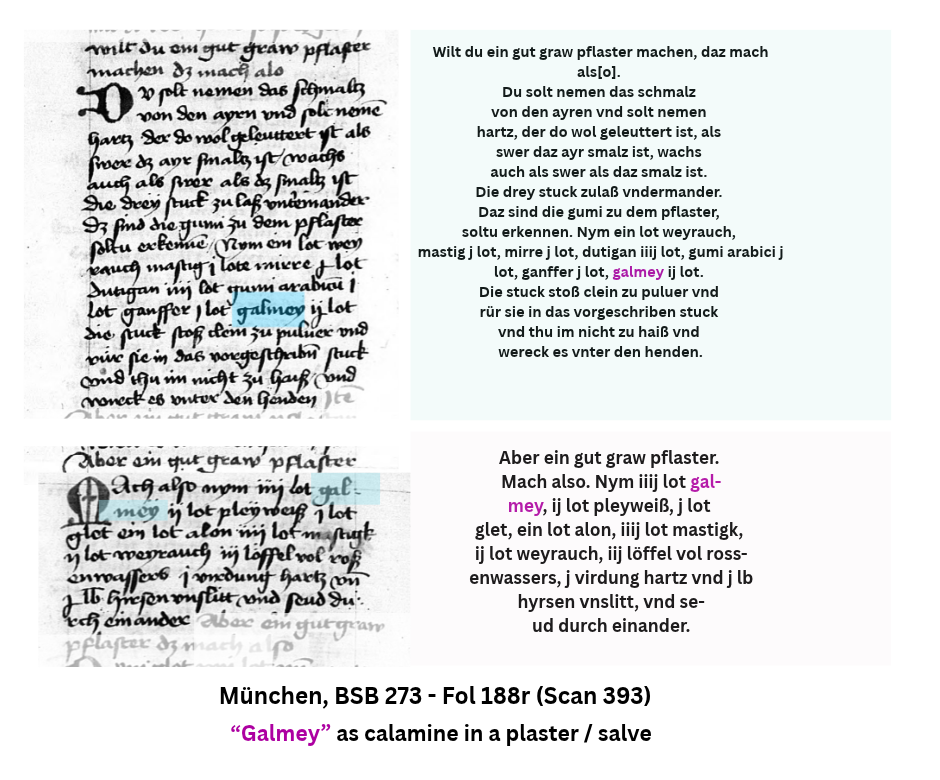
Translation of the first recipe, that starts on the lower left of the page, reads:
If you want to make a good gray plaster. Take the fat from eggs. Take well-clarified resin equal in weight to the egg fat, and the same weight of wax. Melt the three together. These are the gums for the plaster. Take one lot of frankincense, one lot of mastic, one lot of myrrh, four lot of dutigan (probably gum tragacanth), one lot of gum arabic, one lot of camphor, and two lot of calamine. Pound these ingredients into a fine powder and stir them into the mixture described above. Do not let it get too hot, and work it with your hands.
Translation of the second recipe reads:
Another good gray plaster. Make it as follows. Take four lot of calamine, two lot of white lead, one lot of litharge, one lot of alon (probably aloes), four lot of mastic, two lot of frankincense, three spoonfuls of rosewater, one virdung of resin, and one pound of deer tallow. Boil everything together.
2) Copenhagen, Royal Danish Library, GKS 3484 8°, around 1500. (Fol 173v on Det Kongelige Bibliotek)
The repository of this MS is interesting, as the Copenhagen MS of Hildegard’s is the most complete surviving MS of her Causae et curae, in Copenhagen, Royal Danish Library, NKS 90 b.
This one has handwriting a bit harder to read. There are two recipes featuring calamine, as “galmey”:
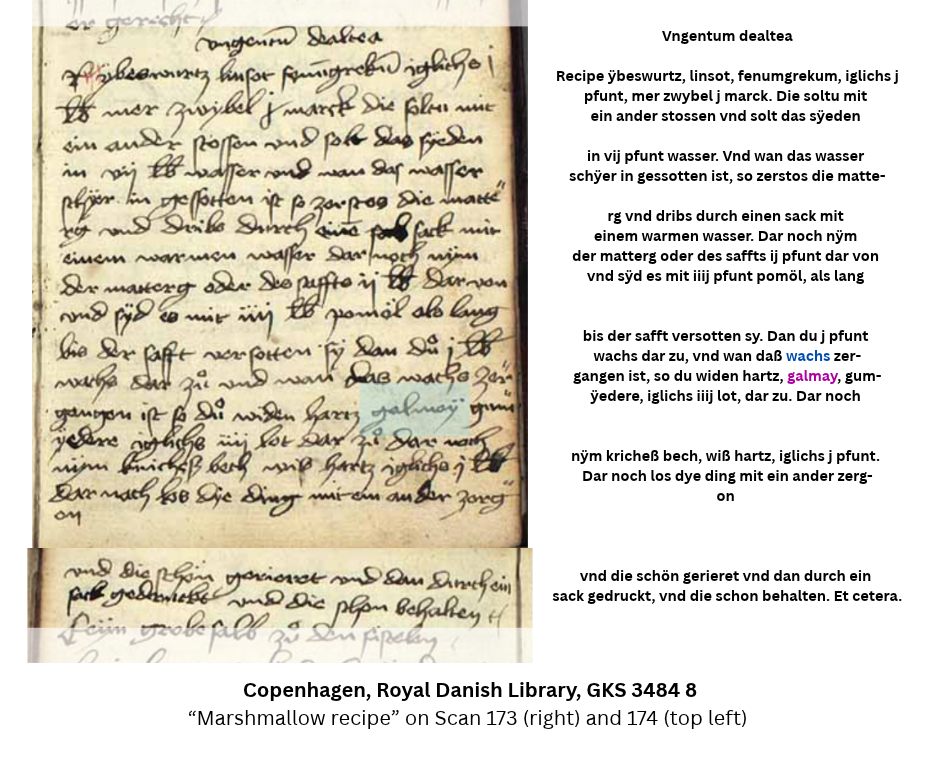
Translation of first recipe reads:
Marshmallow ointment. Take one pound each of marshmallow root, linseed, and fenugreek, and one mark of squill. Pound them together and boil them in seven pounds of water. When the water has nearly boiled away, pound the mash again and press it through a bag with warm water. Then take two pounds of the resulting pulp or juice and boil it with four pounds of olive oil until the juice has boiled away. Add one pound of wax. When the wax has melted, add four lot each of widen hartz, calamine, and ivy gum. Then take one pound each of Greek pitch and white resin. Let the ingredients melt together, stir them well, press the mixture through a bag, and store it carefully. And so forth.
Translation of second recipe reads:
A coarse salve for fistulas. Take bacon fat from a pig three or four years old. Cut it into small pieces and heat them on a metal sheet to render the fat. Catch whatever drips off in cold water. Set the basin of water beside the fire, with a board between the fire and the basin. Set the metal sheet at a slant so it works like a trough. Then take litharge, calamine, powdered lead that has been calcined, and egg fat. Take the rendered fat lying in the water and the other powdered ingredients, and mix them thoroughly together until the mixture has the consistency of a salve. And so forth.
3) Ein new Wundarzney-Büchlein” by Burres, Lorenz. Printed in 1530.
The translation of the first recipe reads:
A gray plaster that forms skin and heals well. Take one lot of mastic, two lots of frankincense, half a lot each of white lead and celandine root, and two lots of calamine. Pound these ingredients as fine as possible. Then take oil from the yolks of eight eggs and a piece of deer tallow larger than half an egg. Melt the oil and tallow together, add the powders, and stir until it cools. If you want to make it especially good, add half a quentlein of camphor.
The translation of the second recipe reads:
Another healing plaster. Take buck tallow, four lots of turpentine, one lot each of wax and calamine, one lot of Holwurzel, and two lots of rose oil. Melt the tallow, wax, turpentine, and oil over a charcoal fire. Then add the remaining ingredients, finely powdered, and stir them together with a spatula until cool.
“Vix” as “wichs / wachs”, meaning “wax”
In both our second and third sources shared above, the word “wachs” is used to mean a wax, or binding agent, to mix into the salve. I feel like a reading of “vix” on 116v for “wachs” is not too much of a stretch, as “v” for “w” sound is plausible, and “x” is often a suffix abbreviation for the “chs” sound.
So what of the “ch” and the “o” ending, after “galmei”?
The “Ch” could be a way to abbreviate “Christus”, or “Christ”, as a way to signify the end. I’ve also seen “Christ o” for “Christo”, so “ch o” could mean the same. We know from Cappelli that “Ch” is a common latin abbreviation for Christ.
A religious ending makes sense with all of the crosses. The Macer floridusm of BSB Cgm 384, is a good example of charms with crosses ending with “amen” or religious terms.
Sources and Additional Information:
“Galmei / Calamine” on FWB (https://fwb.sub.uni-goettingen.de/lemma/galmei.s.0m?q=galmei&page=1) One of the examples in here even says “nym galmei”, comparable to our ending of “so nim g-”