
by Sherri Mastrangelo, 29 October 2026
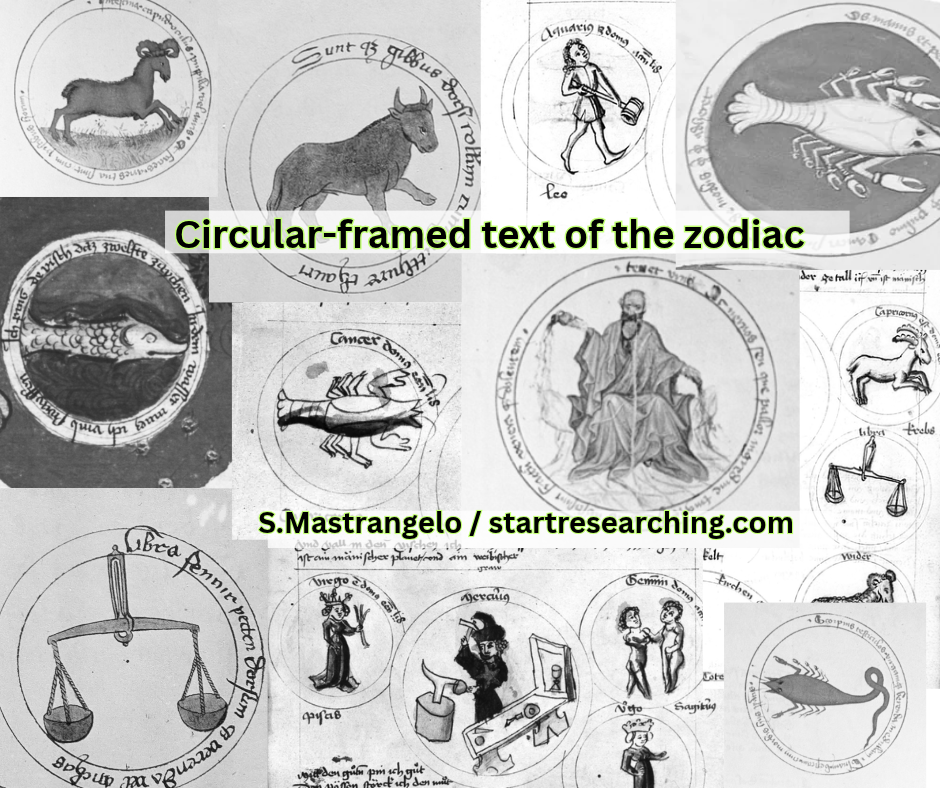
When recently studying the Bellifortis by Conrad Kyeser, I noticed some editions had circular-framed text around zodiac images, similar to the zodiac section of the Voynich MS. It was only evident in two MS of this I was able to find online, his original 1405 presentation copy, Cod. Ms. Philos. 63, created while he was in his hometown of Eichstätt, Germany, and a much later copy, referred to as Codex FB 32009. I also found evidence in three other manuscripts of the same time.
Image above shows creation location of these five manuscripts all within a 200km radius in southern Germany (and Austria).
The manuscripts that contain the circular-framed text around the zodiac signs are
Gottingen Cod. Ms. Philos. 63 - Bellifortis - Eichstatt, Germany, c 1405.
Vienna, Osterreichische Nationalbibliothek, Cod. 3067 - Tyrol area, c 1415 - 1425.
Munich, CGM 595 - Augsburg (Ostschwaben / Eastern Swabia), c 1436
Codex FB 32009 (16.0.7) - Bellifortis, copy - Ingolstadt, after 1442
Bayerische Staatsbibliothek CGM 312 - Losbücher (Fortune telling) - Swabia, 1450 - 1473. Written by Konrad Bollstatter.
These two editions of the Bellifortis, have a special zodiac section that is referred to as the Liber de Septum Signis, or the Book of the Seven Signs. Other copies of the Bellifortis - of which there are many - may show the planets represented by only riders on horses with flags (without the zodiac circles), or the signs / planets are not shown at all - which is why they are not included in this discussion.
In addition to the these two copies of the Bellifortis, there is an earlier draft from 1402 (2° Cod. Ms. philos. 64) that I have not been able to find images for yet.
I was also able to find two more examples of circular text-framed zodiacs within Vienna ONB Cod. 3067, and Munich Cgm 595.
In mapping where all four of these manuscripts where created, shown above, I noticed they are all within a 200km or less radius in southern Germany / western Austria.
1 - Cod. Ms. Philos. 63
Let’s start with the earliest example, the original Bellifortis, created circa 1405 by Kyeser in his hometown of Eichstatt, Germany, Göttingen's Cod. Ms. philos. 63.
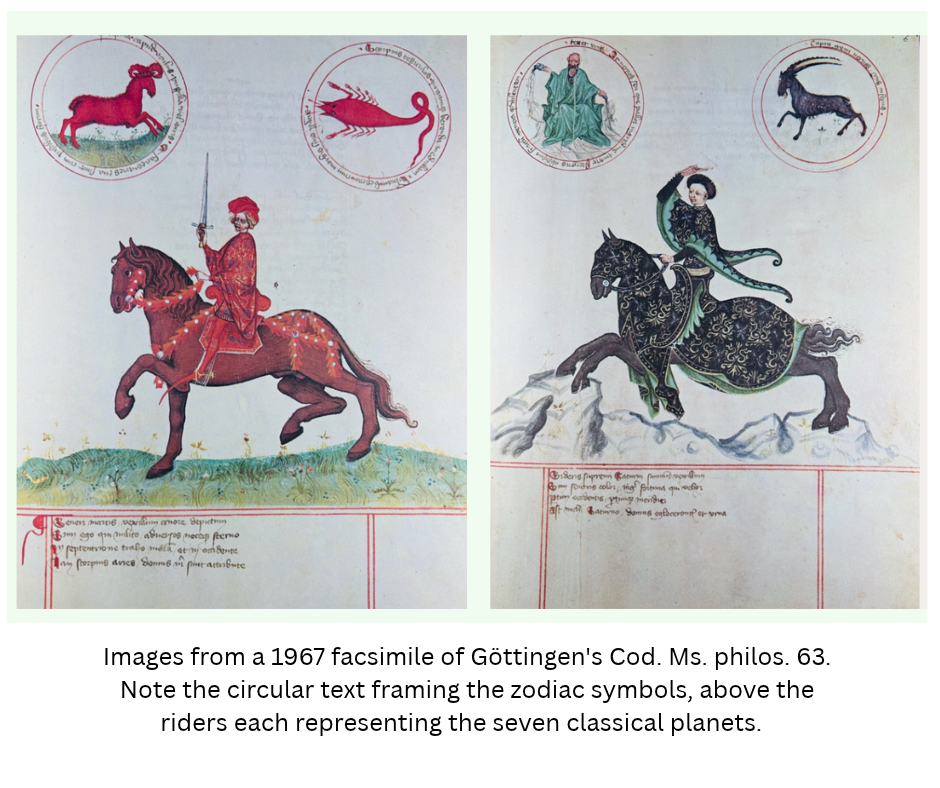
I was able to find a few reproduction photos of Ms. philos. 63
Each horse rider represented a classical planet (Saturn, Jupiter, Mars, The Sun, Venus, Mercury, and The Moon). The sun and moon had one zodiac sign above, while the others each had two - a daytime sign and a nighttime sign.
Future copies that included the horse riders would drop the zodiac circles, and would instead carry banners or flags. The human figures themselves resembled political figures with their looks, such as Barbara of Cilli as Venus, and Sigismund, the King of Hungary, as the Sun. The Bellifortis, or “Strong in War”, was telling the world that these rulers were guided by the stars themselves.
2 - Vienna, ONB Cod. 3067
The next manuscript is not a copy of the Bellifortis, but a composite astrological text written in German and Latin, Vienna, Österreichischen Nationalbibliothek Cod. 3067 (Olim: Philos. 176). It also includes the pseudo-Aristotle “Secretum secretorum” by Christian Feldkircher.
Images from Vienna, ONB Cod. 3067 can be viewed online on The Warburg Institute Iconographic Database. (I believe it is also digitized on manuscripta but that website has been down since the php security flaw).
Cod. 3067 is a form of hemerology, or elective astrology, where the reader determines the best day to complete a task based on the signs and alignment of the planets. These tasks might include taking medicine, planting trees, or starting a relationship.
It should also be noted that I cannot confirm the shelfmark of these images - Vienna ONB Cod. 3067 to be correct, and I know Warburg has made a few mistakes - can anyone offer another source? I do know that Cod. 3068 and Cod. 3069 are versions of Bellifortis, which is interesting.
3 - Munich Cgm 595
Images from Munich, Bayerische Staatsbibliothek, Cgm 595 can be viewed online on The Warbug Institute Iconographic Database. Note the Warburg mistitles the first image as folio 11v of Clm 826, but it’s actually part of Cgm 595, and some of the scans are blurry.
It can also be viewed online on the MDZ in full.
Provenance records in KdiH for Cgm 595 show it from the Augsburg monastery of St. Ulrich and Afra.
4 - Codex FB 32009
This is a later copy of the Bellifortis, produced sometime after 1442, likely in or near Ingolstadt. This manuscript also includes De ingeniis spiritalibus by Philo of Byzantium, 3rd century.
Images from Innsbruck, Tiroler Landesmuseum Ferdinandeum, FB 32009 (Cod. 16.0.7) can be viewed online on The Warburg Institute Iconographic Database
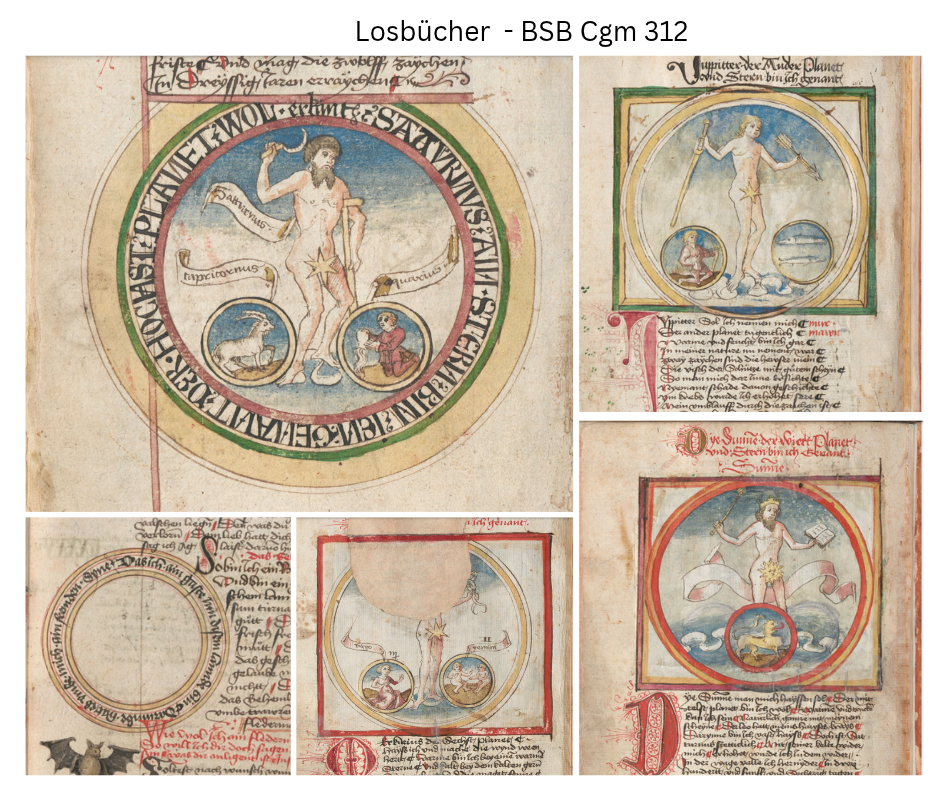
Bayerische Staatsbibliothek CGM 312 can be viewed online at the MDZ. It is the Losbücher, a fortune telling book (or book of fate), from Swabia, 1450 - 1473. We actually know the scribe for this one - Konrad Bollstater, who worked for the Count of Oettingen before living in Augsburg.
Only one of the zodiac images is framed with circular text (top left of the image above) on folio 51v of the manuscript. There are also empty circular text images on 42r and 44v. But if you keep going to folio 83r, 83v, and 84r there are the zodiacs:
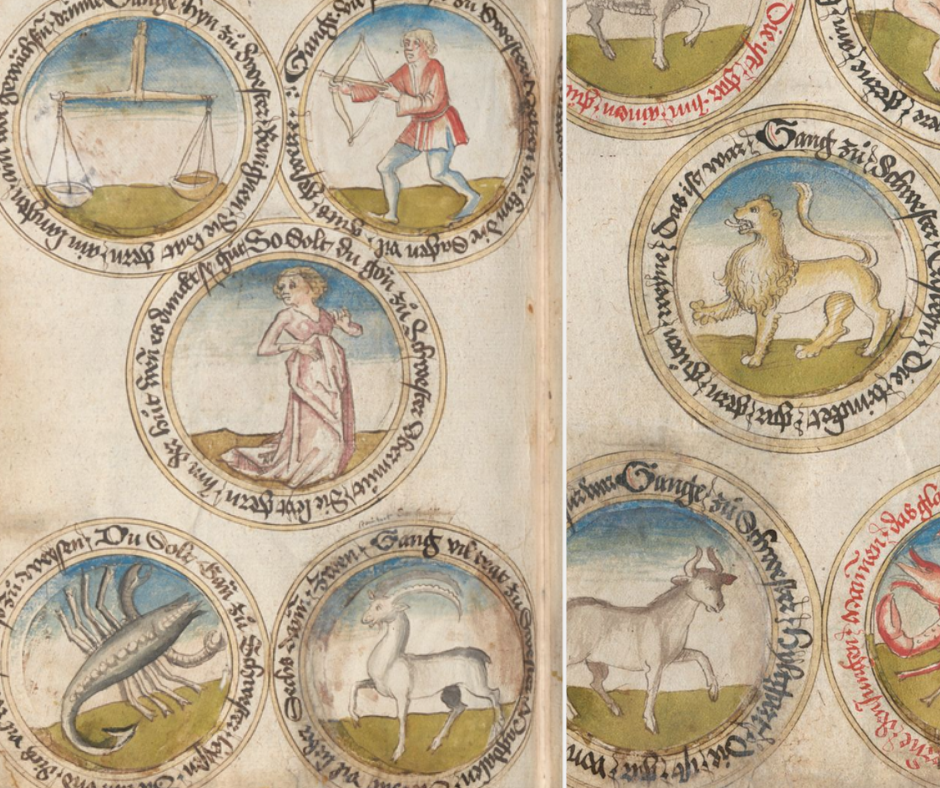
In all of these manuscripts, these are not simply images of the zodiac signs - but are the zodiacs related to their planetary houses, and how the traits of these signs and planets govern our lives. There’s a lot to unpack about the meaning here - especially diving into the astrological sources that Kyeser used for Bellifortis - which I’m looking forward to diving into on future blog posts.
It should be noted that the Diebold Lauber workshop, of much interest to Voynich enthusiasts, was active during part of these manuscripts, 1427 - 1470. It was located in Hagenaue, about 150 miles west of Eichstatt.
The question remains - is the use of circular-framed text around zodiac signs limited to this area of Bavaria (Eichstätt, Tyrol, Augsburg, Ingolstadt, and Swabia)?
Did it originate here and spread? Are there examples from other areas?
Do you have any examples of zodiac signs framed by circular text - whether they are from this region or not? Please share!