The Starred Paragraphs of the Voynich are Pythagorean Sentences, or Maxims

by Sherri Mastrangelo, 23 May 2026. Last edited 10:14 pm PST.

In addition to the “Visual Elements of Plato within the Voynich” I’ve discussed in the previous blog post, in which I link parts the Astrological section of the Voynich to Timaeus, part 1 of Plato, and parts of the Biological section to the Timaeus, part 2, I am noticing many more Pythagorean aspects throughout the whole text. Like the monad circle within the circle diagram on Folio 57v. And perhaps the Botany section has to do with the vegetarianism of Pythagoreans?

Anyways, I believe the starred paragraph section of the Voynich are a collection of sayings, or moral maxims (or ethical aphorisms, or gnomes), of Pythagorean beliefs, of the specific collections proposed below. In fact, I propose we rename this section of the Voynich “The Starred Sentences” and no longer refer to them as recipes.

Originally I thought it was the “Sentences of Sextus”, but this seems like too high an amount of 451 (or larger) and so I looked at which collections these were drawn from, and came much closer.

In this section of the Voynich we have 324 stars, each aligned more or less with a sentence or a few. There are also at least two missing folios (109r / 109v and 110r / 110v). Each folio averages around 14 stars, with some like 103r higher at 19, and three folios at the lowest end of 10 stars (105r, 105v, and 116r), and the rest vary in amount. So if we assume our 4 missing folios at 14 stars each, it would give us 56 added stars, or 380 total goal (324 we have plus 56 estimated missing = 380). With me so far?

Here’s what I suggest:

  • The Pythagorean Sentences = 123

  • The Sentences of Clitarchus = 130*

    The Golden Sentences of Democrates = 80 (some have 84?)

  • The Similitudes of Demophilus = 59**

Adding these up we get 392. Pretty close to our 380 estimate.

Update (as of Sunday night, May 24th): I have a possible new order, without the Sentences of Clitarchus, but adding in the Sentences of Demophilis, and the Golden Versus:

Pythag. Sentences - 123
Sentences of Democrates - 80
Similitudes of Demophilis - 59
Sentences of Demophilis - 45
Golden Versus - 71
Total of this combination = 378

This version is closer to my estimate of 380 than the other combo with 392.
  

It would mean our missing four folios would have to total 68, or average of 17 stars per page. Well within existing Folios (remember 103r has 19). I wonder if Folio 58r / 58v belongs in this section as well, which would bring our missing stars total down.

I would love it if some experts could confirm these numbers, I’m just going off the sources I have found. *Per Chadwick, the manuscripts and maxims in the Sentences of Clitarchus are:

  • 1) Parisinus gr. 1630, fol. 186 = 93 maxims

  • 2) Vaticanus gr. 1144, saec. xv, fol. 232 = 59 - 22 contained above = 37

  • 3) Bodleianus Auct. F. 6. 26, saec. xv, foil. 183–7 = 38, all within 93 of Par.

  • 93 + 37 = 130.

**As for The Similitudes of Demophilus, there are 45 in Sallustius, but 59 in Bridgman - and I also counted 59 in a 1638 text.

So our variables are 1) how many are sayings are actually in each collection, and 2) how many stars are we actually missing in our four missing folios.

Let me give some selections of the above listed collections:

  • The Pythagorean Sentences (From my understanding, the term “Pythagorean Sentences” can mean a wide encompassing selection of many of the fragments named in this post, or it can be a specific collection of 123 maxims which include some of the fragments - is this right?) (*Greek version from Chadwick’s Sentences of Sextus)

    • Edit: Another point I want to make! The Pythagorean Sentences seem to be the only ones that have an “a” and “b” subsentence, which looks like what might happening on the top of Folio 112v in the VM perhaps?

  • The Sentences of Clitarchus *(and in Greek). (I think some of the Sentences of Clitarchus are included in the Sentences of Sextus - not that it comes from it, but that both may be based on an earlier source, and there is some overlap - I need an expert to help here!)

  • The Golden Sentences of Democrates (these may have some overlap with Stobaeus)

    • “If any one will give his mind to these sentences, he will obtain many things worthy of a man, and be free from many things that are base.”

    • “The perfection of the soul will correct the depravity of the body; but with the strength of the body without reasoning, does not render the soul better.”

    • “He who loves the goods of the soul will love things more divine; but he who loves the goods of its transient habitation will love things human.”

  • The Similitudes of Demophilus (Edit: At first I thought the “Sentences of Demophilus” were the same, but they appear to be different.)

    • “Flattery is like painted armour, because it affords delight, but is of no use.”

    • “Learning is similar to a golden crown; for it is both honourable, and advantageous.”

    • “Flighty men, like empty vessels, are easily laid hold off by the ears.”

And here are some additional candidates, with selections of each:

  • The Pythagorean Sentences of Demophilus (45)

    • “Request not of Divinity such things as, when obtained, you cannot preserve; for no gift of Divinity can ever be taken away; and on this account he does not confer that which you are unable to retain”

    • “Be vigilant in your intellectual part; for sleep about this has an affinity with real death”

  • Golden Verses (71)

    • “First worship the Immortal Gods, as they are established and ordained by the Law”.

    • “Reverence the Oath, and next the Heroes, full of goodness and light”.

  • Pythagorean Ethical Sentences from Stobaeus (55)

    • “Do not even think of doing what ought not to be done.”

    • “Choose rather to be strong in soul than in body”

    • “Be persuaded that things of a laborious nature contribute more than pleasures to virtue”

    • “Every passion of the soul is most hostile to its salvation”

    • “It is difficult to walk at one and the same time in many paths of life”

  • Sentences of Sextus (451 - more with greek appendix)

    • “To neglect things of the smallest consequence, is not the least thing in human life.”

    • “The wise man, and the despiser of wealth, resemble God”

  • The Protreptics of Iamblichus (15?)

    • “As we live through soul, it must be said that by the virtue of this we live well; just as because we see through the eyes, we see well through the virtue of these.”

    • “It must not be thought that gold can be injured by rust, or virtue by baseness”

  • The Sentences of Porphyry (28)

    • “All body is in space: no one of the things which in themselves are incorporeal, or anything of such nature, is in space”

    • “The things which in themselves are incorporeal, from the fact that they are superior to all body and space, are everywhere; not in a sundered, but in an undivided condition”

  • The Pythagoric Symbols

    • “When going to the temple to adore Divinity neither say nor do anything in the interim pertaining to the common affairs of life”

    • “Neither enter into a temple negligently, nor in short adore carelessly, not even though you should stand at the very doors themselves”

Are there others we should consider? “Sentences of Chares of Mytilene”, or “Sentences of Epicharmus”?

Edit: With regards to the Sentences of Sextus, I think it should still be considered, though it appears to be more sentences than we have stars. Though I believe some of these collections appear within the Sextus…

And which combination is most likely? How does this contribute to our understanding of the written cipher?

Some Sources & Reference:

Bridgman, William and Thomas Taylor. “Translations from the Greek, viz., Aristotle’s synopsis of the virtues and vices. The similitudes of Demophilus. The golden sentences of Democrates. And they Pythagoric symbols with the explanations of Jamblichus” London, 1804. As found on Internet Archive.

Chadwick, Henry. “The Sentences of Sextus: A Contribution to the History of Early Christian Ethics” Cambridge University Press, 1959.

Demophilus(?) “Demophili, Democratis et Secundi veterum philosophorum sententiae morales” 1638.

Elter, Antonio, ed. “Gnomica 1: Sexti Pythagorica Clitarchi” 1892.

Johnson, Thomas Moore. “Fragments of Iamblichus’ Protrepticus”. 1907.

Taylor, Thomas. “Iamblichus’ Life of Pythagoras, or Pythagoric Life” London, 1818

Taylor, Thomas. “Sallust, on the Gods and the World: The Pythagoric Sentences of Demophilus; Five Hymns by Proclus; Five Hymns by the Translator” 1795 Facsimile.

Smith, William, ed. “Dictionary of Greek and Roman Biography and Mythology, Vol.1” Little, Brown, and Company. Boston, 1870. As found on Internet Archive (RE: Stoebus quoting Democrates: https://archive.org/details/dictionaryofgre01smituoft/page/974/mode/2up)
Visual Elements of Plato within the Voynich

by Sherri Mastrangelo, 20 May 2026 - Last edited 22 May 6:43 pm PST

For this post, I am using “The Timaeus of Plato” by R.D. Archer-Hind, M.A., 1888 edition, as found on one of my favorite websites, the fabulous Internet Archive. It is shown in Greek with English translation, though the Stephanus numbers are a little difficult to parse, and thus may be off slightly in my quotes below (also note that these numbers are a 16th century invention, so don’t look for them in the VM).

Additional modern alternatives include translations by Peter Kalkavage, Donald J. Zeyl, Desmond Lee, and R.G. Bury. I have also ordered by Magee, but it’s not here yet.

Noteworthy translations in Latin are by Marcus Tullius Cicero (written 45BC), and Calcidius / Chalcidius (4th Century AD). According to the University of Notre Dame’s Medieval Studies Research Blog (which I’ll call MSRB), the Cicero translation was the primary Latin source until about the 11th Century, then interest shifted to the Calcidius. Both were fragmented versions, Cicero ending at 42b and Calcidius at 53b. I have ordered “On Plato’s Timaeus” by John Magee (2016), which focuses on the Calcidius translation, but it has not arrived yet.

During the Italian renaissance, there was a rise of humanism and resurgence of classical Greek philosophy. This did not start with the Fall of Constantinople, the Florentine Academy, and the Medici family as some believe, but earlier - from Petrarch to Chrysoloras to the Council of Florence. It is here we find the carbon-dating for the paper of the Voynich, along with a wide reverence for Plato.

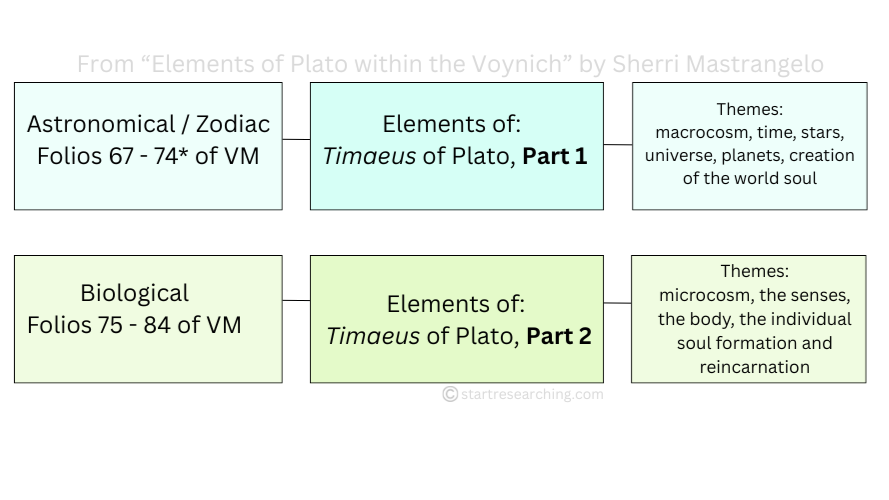
“Plato’s Timaeus was the most widely available Platonic work throughout most of the Middle Ages” (MSRB), while the Plato catalogue we know today was not. Timaeus was about the universe, the world itself and our place within it. We see this macrocosm of the universe in the Voynich, with the astrology section, followed by the microcosm of the body and soul in the bathing section. To be clear, I am not drawing authorship to Plato by any means. I am, however, almost certain that the Timaeus was referenced, as shown in my associations below.

Let’s start with the biological section, which I believe shows elements of Plato’s Timaeus visually (and likely in the text). Namely, the story of the creation, or reincarnation, of the soul.

In my work with the Voynich I have reordered this section, so that it no longer starts with 75r, but 76r - a page of text. On the reverse, we have 76v. Here we start around section 42E of Timaeus, within the works of Reason, where the creator “gave into the hands of the young gods, to mold mortal bodies, and having wrought all the residue of the human soul that needed yet to be added, to govern and guide as nobly and perfectly as they could the mortal creature”. To do this, -

“they borrowed from the universe portions of fire and of earth and of water and of air, on condition that they should be returned again…and making of all the elements one body for each creature, they confined the revolutions of the immortal soul in a body in-flowing and out-flowing continually…” - Timaeus, 43A

“…and though they are in motion, it is motion without law, sometimes reversed, now slanting, and now inverted…” - 44A

I will not say much about these connections at this time, as I want to draw attention to the images and quotes.
(Here I skip folio 77r and folio 77v)

“but when the stream of growth and nutriment flows in with smaller volume, and the revolutions calming down go their own way and become settled as time passes on, then the orbits are reduced to the form that belongs to the several circles in their natural motion…” - Timaeus, 44B

(I believe next should come 81r and 81v in my order, to the right of 78v)

“…they gave it the body for a conveyance and for ease of going; whence the body was endowed with length and grew four limbs that could be stretched and bent, which the god devised for it to go withal, and by means of which clinging and supporting itself it is enabled to pass through every place, bearing at the top of us the habitation of the most divine and sacred element. In this way then and for these reasons were legs and hands added to all mankind…” - Timaeus, 44E

“…bearing at the top of us the habitation of the most divine and sacred element…” - Timaeus, 45A

“…and first of the organs they wrought light-giving eyes, which they fixed there on the plan I shall explain. Such sort of fire as had the property of yielding a gentle light but not of burning, they contrived to form into a substance akin to the light of every day. The fire within us, which is akin to the daylight, they made to flow pure smooth and dense through the eyes…” - Timaeus, 45C

“…For the gods had devised as a safeguard of the sight the structure of the eyelids; and when these are closed, they shut up the force of fire within; and when these are calmed, quiet ensues…” - Timaeus, 45E

(Since I moved 81r and 81v, next should come 82r)

“…And if the quiet is profound, sleep with few dreams falls on us; but if some of the stronger motions are left, according to their nature and the places where they remain, they engender visions within us, and when we awake are remembered outside us…” - Timaeus, 46A

“…And left appears right and right left, because mutually opposite particles of the visual current and of the object seen come into contact…” - Timaeus, 46C

What follows is harder to place. Did they reference the fragmented Calcidius version, which went only to 53b? If you remember, the translation of Cicero ended at 42b - and since I’ve found connections through 46C I think we can exclude Cicero.

Or more than likely, the Timaeus is only one selection of many, not just of Plato but of others like Socrates and Aristotle - as well as Christian traditions they may have been trying to intermingle (especially based on the ideas of the Council of Florence - which definitely need a closer look here, as it is related to the aspects of purgatory and the purification of the human soul).

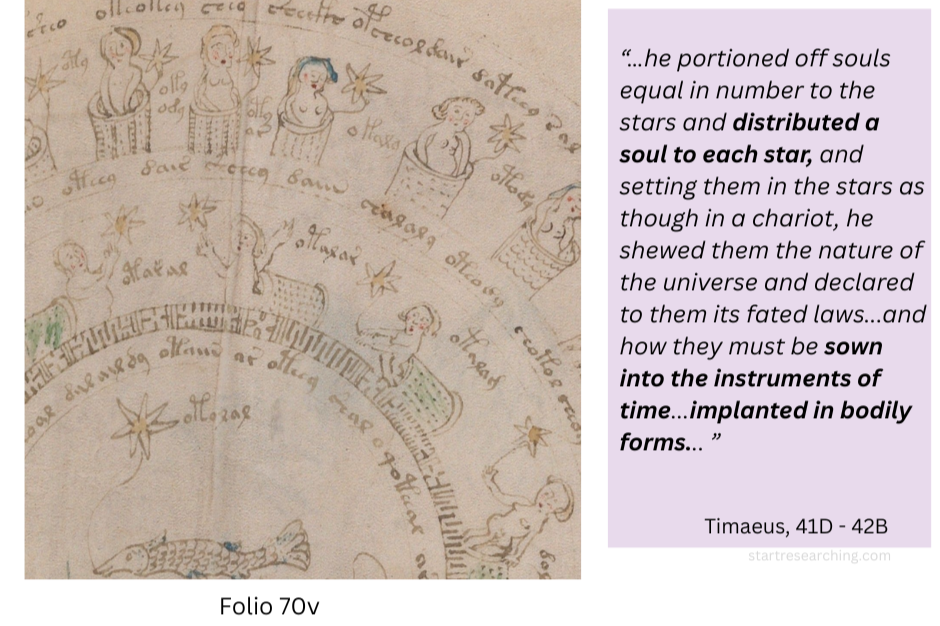
That said, I do see other elements of Plato’s Timaeus in other sections. For example, in the zodiac (which we know was after the time of Plato) I noticed this alignment below:

…”he portioned off souls equal in number to the stars and distributed a soul to each star, and setting them in the stars as though in a chariot, he shewed them the nature of the universe and declared to them its fated laws…and how they must be sown into the instruments of time…implanted in bodily forms…” - Timaeus, 41D - 42B

In Folio 70v, I believe it shows not only the stars that each “soul” has been given, but also the metaphorical bodies - or barrels - given to each, which they must escape from, as shown in the inner ring.

The Timaeus is also a great way to link this astrological section with the biological, as it flows perfectly in order within - of the universe, of time and space and planets and the world soul, to the formation of the individual soul and body in the biological section of the Voynich. The way this matches up in order with the Timaeus and flows through so perfectly has me convinced, and I am so excited to research more.

And remember, these quotes from Timaeus are from an 1888 version, and if you want to try to match up any of the text to decipher, your best bet is likely the Calcidius translation, or a different language translation of such.

Perhaps something within this work, like the Pythagorean aspect, or Plato’s favorite numbers, or any of the geometry and forms - has to do with the cipher…

I have much more to say on this topic (the views on time and the universe! other aspects of Plato in other sections! what everything I’ve learned means for the language of the VM!) but will publish this post and edit later as time permits.

Update: I wanted to include a summary of my findings so far, as of Friday night, May 22:

All the best,

Sherri


Sources:

Archer-Hind, R.D., M.A. “The Timaeus of Plato” London, MacMillan and Co., 1888, as found on the Internet Archive.

Kalkavage, Peter. Plato Timaeus, second edition. Focus, an imprint of Hackett Publishing Company, Inc. Indianapolis / Cambridge. 2016. As found online (https://dn710003.ca.archive.org/0/items/plato-keith-whitaker-parmenides-focus-1996/Plato%20-%20Timaeus%20%5Bkalkavage%5D.pdf)

Medieval Studies Research Blog (MSRB). “Plato, Mathematician and Myth-Maker”, Medieval Studies Research Blog: Meet Us at the Crossroads of Everything, Hosted by the University of Notre Dame’s Medieval Institute, 5 June 2024. University of Notre Dame. (https://sites.nd.edu/manuscript-studies/2024/06/05/plato-mathematician-and-myth-maker/)


More on first character start vertical patterns within the Voynich

By Sherri Mastrangelo, 29 September 2025.

This is a follow-up to: “The 490 - a pattern?”

In the previous post, I shared samples of vertical patterns within the starting characters of some paragraphs.

I analyzed many of the text heavy pages, folios 1 - 57r, 58r, 58v, 65v - 66v, 75r - 87v, 90r - 96v, 103r - 116r. This is ignoring the wheel on 57v, the zodiac section, some of the other wheels and foldouts, and the heavily labeled root section. In total I used 174 pages, with 3,784 lines of text (note that number for my later probability equations). When a folio had a separate vertical column in front of the text paragraphs, such as 76r, it was ignored.

I identified 18 unique starting characters for all the lines.

The highest string-length of characters that repeat elsewhere is “7", with two different pairs of seven string length. The first pair can be found on 14r and 104r, and the second pair on 105r and 106r, as pictured below:

The next highest string length is 6 characters, with 22 different matching pairs found - though with a heavy amount of overlap between sets. For example, the string of seven length above in 14r, also includes the the string of six on 15r, “0 9 0 4 9 0”, as well as the string of five “9 0 4 9 0” counted in the data.

Of the 174 pages I analyzed, I found vertical patterns in the first characters of 5 string length or more in 88 pages or a little over 50% of the text. Again, with overlap. Here’s a sample:

You’ll notice I prefer not to work with EVA characters. I also made judgements about the characters, as some are more obvious than others. The intent was to look for patterns.

So does any of this mean anything? Are repeating patterns a natural consequence of having so many similar “words” in the manuscript - or at least so many similar prefixes? Or of a cipher? Or perhaps a lazy scribe, copying from previous pages as he made up the text?

Let’s look to probability equations - especially the Poisson distribution (same birthday) model. This is where ChatGPT+ comes in clutch. For this, my first prompt was: “Assume a manuscript of 3,784 lines of text is in a grid of various column length. Let’s look at the first column, which has 18 unique possible characters. How likely is it for a vertical pattern of seven characters to have an identical seven string pattern elsewhere in the column?”

This gave me a 1.16% chance, or about 1 in 86 that at least one 7-character vertical sequence repeats. Seems pretty reasonable actually. So how likely are two different pairs of seven string length, as shown in the image above?

That’s about 0.0067%, or 1 in 15,000, which means the text is not random nonsense.

Here’s what that can mean:


So “not random”. Which could mean a language, or a cipher. Or could still mean a scribe or two copying from other pages. It really doesn’t tell us much, does it? What do you think?


The 490 - a pattern?

By Sherri Mastrangelo, 20 September, 2025.

See the update to this post here > “More on the 490 pattern…”

Looking at the vertical list on 66r, I wondered if these pattern was repeated elsewhere, and also if any other pages showed a vertical pattern.

The first repetition that jumped out at me, is the “490” that occurs vertically using the first characters of each paragraph.

Let’s look at some examples:

How many of these before it would be considered a pattern? Six more?

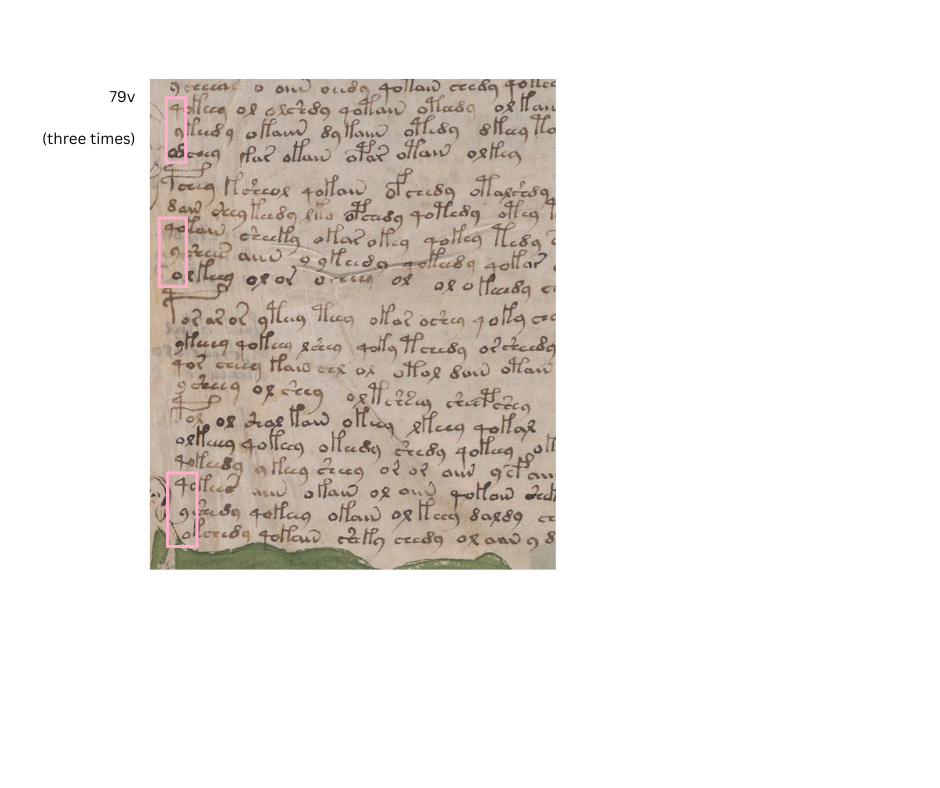
We’re at 14 pages (15 examples), then three more on 79v, shown below:

So 18 examples total in 15 pages I believe.

Could this tell us anything about the pattern of a cipher? Or which characters are substituted for others on other pages?

The next step would be to summarize the starting characters of each line for the whole manuscript. With the pages a little out of order it’s hard to see if a pattern stretches across pages, but I’m working on the page order for a separate post.

Below find a few more of the starting character patterns I’ve observed. These are not a comprehensive collection, as I’m still making my way through the text.

Do you think these repetitions are just a byproduct of so many similar words and characters? Or is it alluding to something more?


The Pattern of the Wheel on 57v

31 July, 2025 by Sherri Mastrangelo

On folio 57 v of the Voynich, in the second wheel, there is a simple pattern of 9 symbols that repeats 4 times - or so I thought at first. As I examined it closer, it seems that the first two patterns use the “one leg, one loop” glyph as the ninth character, and the second two patterns use the “one leg, two loops” glyph as the ninth character.

I couldn’t find anyone else discussing this online, so I’ll share some visuals to discuss.

First, here is the wheel in question, with the second inner circle from the top highlighted in four sections. I start the pattern at the “o” character, as the faint lines before it may indicate a start. It is also below the exterior word.

The pattern continues for 17 characters. These are not all of the symbols that occur in the manuscript. In fact, there are several here that don’t seem to occur anywhere else (possibly the 5th, the 10th, 13th, and 17th in the chart below).

As mentioned before, the first two patterns, A and B, are the same with the one leg, one loop, while patterns C and D both have one leg, two loops as the ninth character. Do these glyphs signify anything within the whole text? Or do the numbers 9 or 17 mean anything?

Are there patterns in the other circles on 57 v? Do they relate to this pattern?

Does this pattern occur anywhere else in the manuscript?

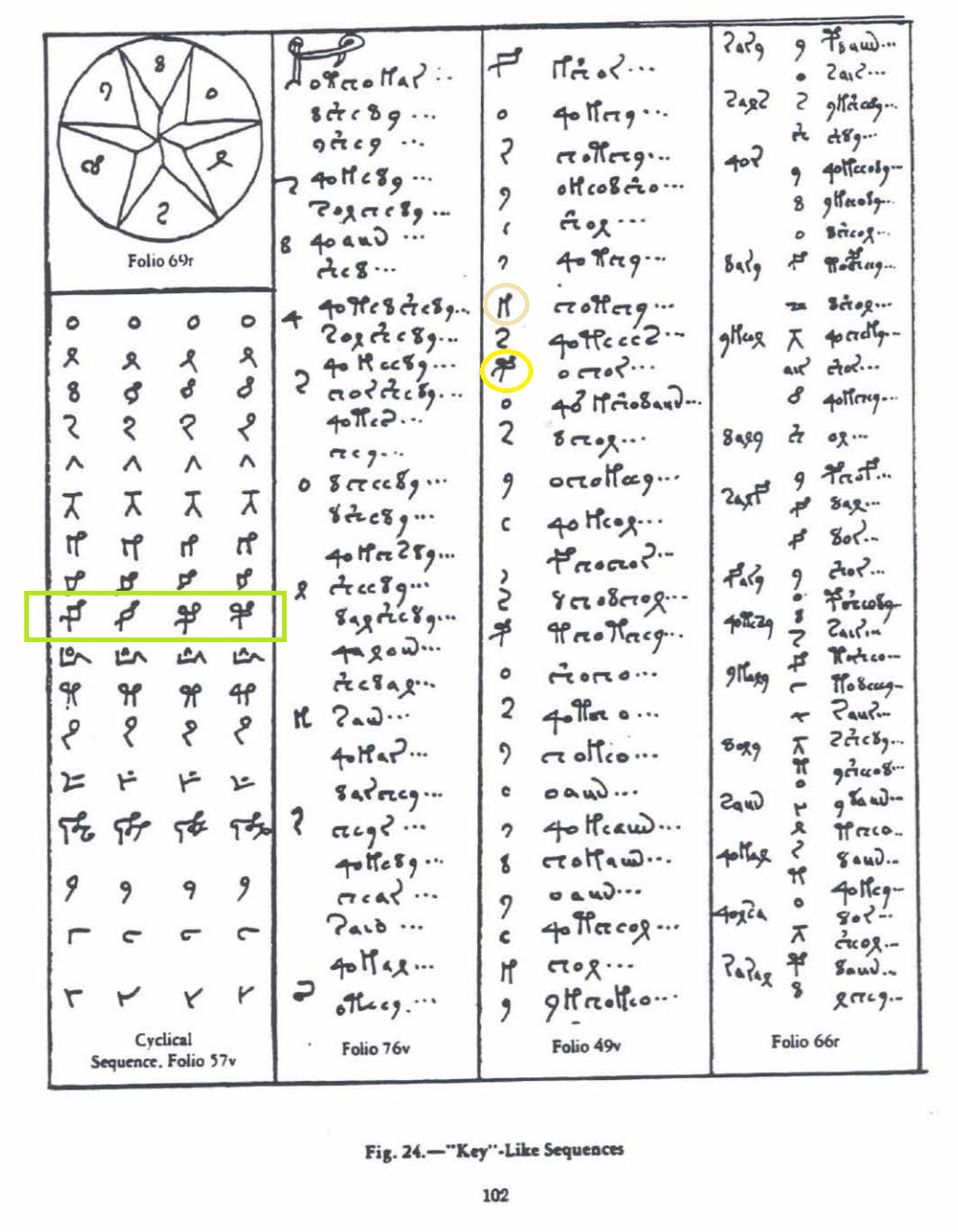
  • On folio 49v, there are several characters in a vertical line, starting with the “one leg, one loop” glyph. The pattern here seems to repeat in an interesting way too.

  • On folio 66r, there are several characters in a vertical line. Within this line, is the only other place in the manuscript where the 6th character in the chart above appears.

  • On folio 69r, within the circle, there are six of these characters.

I would like to also draw attention to the work of Mary E. D’Imperio, in her publication “The Voynich Manuscript, An Elegant Enigma” for the National Security Agency in 1978, the chart “Fig. 24 “Key” Like Sequences” does show these patterns, though she doesn’t draw attention to the changing ninth character on the wheel:

The colored marks (green square and yellow circles) in the chart above are my own additions.

Does D’Imperio think that change in the pattern of 57v is not worth mentioning?

Also, the pattern she shows on Folio 76v is actually on 76r prior.

On 49v, I highlighted that the seventh character (two legs, one loop) matches the wheel pattern, as does the ninth (one leg, two loops).

I would also be curious if any of the words with the wheel of 57v show up on these other folios. I’ve seen a few of the words on 66r, but I need to do more research on this.

Would love to hear your thoughts - or please share any relevant links.

Update:

On the Voynich Ninja forum, a user shared this relevant thread from 2016: https://www.voynich.ninja/thread-1008.html

There are also at least two relevant blog posts by Nick Pelling on Cipher Mysteries from 2010 and 2017: https://ciphermysteries.com/2010/07/01/astrolabes-nocturnals-and-voynich-manuscript-page-f57v and https://ciphermysteries.com/2017/08/31/voynich-f57v

Any other related posts?


Extra "C" as a possible null character in 102r2 (versus 32v)

5 April 2025 by Sherri Mastrangelo

While taking a look at the blue flower / herb on 32v, I learned from other researchers that the same flower can be matched internally to one on the top right of folio 102r2 (See: voynich.ninja/thread-4067) so I decided to compare the text on both pages to look for any repeating characters that might signify a name. I found two words of interest, as well as an interesting pattern that might be evidence of an added “c” as a null character in a cipher on some pages.

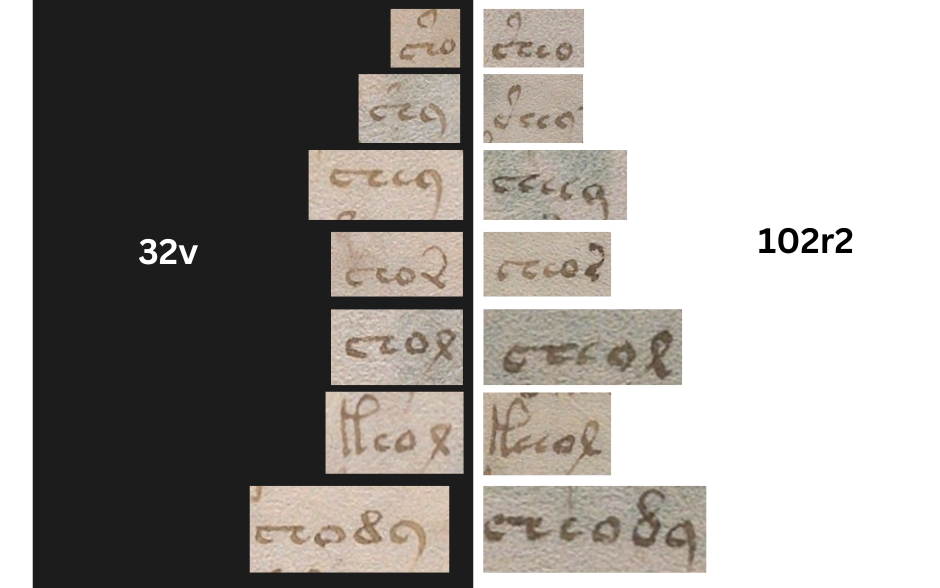
There are two paragraphs on 32v and one image, with three paragraphs on 102r2. The image below depicts my comparison. There are a handful of words that are the same, with two that are more unique than others, at least in my opinion. These two words are illustrated with the red and black arrows below. Perhaps these words are related to the name of the plant / herb that is the same on both. It should also be noted that these words appear in different order on each page, though on both they are in the same sentence.

The above image shows how the words highlighted in white become the green on the right side with the added ‘c’ character. Yellow are the same on both, with special attention to two of the more unique words.

With only a handful of words the same between pages, it seems to me a similar cipher is used on both while also changing the meaning of only a few characters, and perhaps adding a few nulls - like the ‘c’ character. I won’t be sharing more about possible translation in this post, but I do have my own theories.

Here are the seven words I’ve identified below - are these the same words with a null “c” added on the right? Or two different words?

Above: at least seven of the words from 32v have a “matching” version on 102r2, if you add a "c” character

None of the words from 102 with “extra c’s” appear on 32v - however, there are at least two of the words from 32v on 102 (evidenced in white highlighted words on the right side of the first image).

Which scribe wrote 32v verse 102r? According to Dr. Lisa Fagin Davis and her bifolio chart, Scribe 1 is responsible for both 32 and 102.

So what questions am I left with?

There’s actually not that many decorated gallows or bridges. In addition to the one above on 102r2, they can also be found on 14v and 105r. There are also ones on 78r and 78v that may count as well. Note also that 102r2 is a bridge, and the decorated character in the example below is almost a bridge…

Do the surrounding ‘star pages’ have as many words with extra c’s?

What about 14v? 78r and 78v?

The Voynich Zodiac & the Labors of the Months

by Sherri Mastrangelo, 7 March 2025 (edited 8 March).

Perhaps this is a new insight, or perhaps it is not. The vast wealth of research on the Voynich Manuscript is difficult to parse completely, as is the manuscript itself, though I am attempting both!

I’m starting my first thought somewhat in the middle, in the Zodiac section, from Beinecke Folio 70v through 73v, of the twelve circles representing various zodiac signs and months (with two repeated, and two missing), and I propose a meaning behind this section that is either agricultural or medicinal.

The first circle shows two fish, a sign of Pisces (70v1), and in medieval astrology Pisces is affiliated with the month of February. Yet here someone has labeled (what appears to be) ‘March’. The signs and months continue, slightly off kilter, but in order. Aries / March yet labeled April, Taurus / April labeled as May, Gemini / May labeled June, and so on, through the scales of Libra / September shown as the month of October. Aries appears twice, as does Taurus. Missing are Capricorn / December and Aquarius / January.

These labeled names are not incorrect, but they are simplified, to show purpose, as was done in similar texts of the time that were written as agriculture or medicinal guides. For example, in part of 72v we see the image of the scales in the center of the circle, labeled with (what appears to be) ‘October’. The scales are associated with the sign of Libra, which occurs about September 23 through October 22 - so largely in the month of October. If you are writing a guide related to the best times for planting or harvesting, or to perform a ritual, experiment, or health practice, you would generalize the time - it wouldn’t be an exact date.

We can also see this depicted in medieval ‘Labours of the Months’ artwork, such as the The Très Riches Heures du Duc de Berry (est. between 1412 - 1416), and in many other versions of the Books of Hours from the early 15th century. I’ve seen blog posts about comparisons between the zodiac symbols of these works and the Voynich, but not on the parallels of labors within the months.

In these works, April was typically associated with planting. Perhaps this is why April and May were included twice - the most important, or work heavy, time of year. I feel this also helps to tie the botanical section with the zodiac a bit more as well.

Above left: an excerpt of folio 70v of the Voynich Manuscript, and above right: a page from the Book of Hours, showing that this is the time of year for sowing the fields.

It’s also important to note that the “new year” did not fall in January, but in March, which is why our zodiac in the Voynich starts with Pisces (March simplified). Specifically, on the Christian holiday of March 25th, the “Feast of the Annunciation”. In Christianity, this holiday celebrates when the Archangel Gabriel told Mary she would be the mother of Jesus. I am not linking the Voynich with Christianity here, only that the start of the year would have been in March. The start of the calendar year on March 25th is called Incarnation Style. Though Pope Gregory XIII introduced the Gregorian calendar in 1582, it still wasn’t used in much of Italy and Europe until 1750, when the New Year was changed to January 1st.

The start of the new year was marked with a sundial (perhaps figured on 67r2 - the page with rubricated text and 12 words arranged in a circle, or perhaps depicted as the tiny ‘clock’ on the large foldout around 85v), in buildings, when the light of the sun reached through a church window and hit the altar at midday.

Labors of the Months existed not just in books and manuscripts, but in carvings and artifacts of buildings as well. Some with the zodiac symbols, some without. A few examples:

Window roundel of the month of August, circa 1450-1475

Labours of the Months, by Luca della Robbia, from the ceiling of the Medici Palace, circa 1450s

Labours of the Months, tapestry from Alsace, ca 1450

Strasbourg Cathedral, France, occupations with zodiac on facade, late 13th to early 14th century (along with many astronomical sundials and clocks)

St. Augustine’s Church in Kent, 12th Century

Labors of the Months with Zodiac in floor mosaic of the Otranto Cathedral, 1166

Zodiac signs and Labors of the Months in France, Church of Sante-Marie-Madeleine

Which months were associated with which tasks? Lisa L. Spangenberg has a summary on digitalmedievalist.com that includes planting in April, wheat harvesting in July, and so on. It is also important to note that the time the tasks were done may have changed depending on the climate of the region. For example, when it was warmer in the north, the fields may have been worked earlier than in the south. Furthermore, the tasks may have changed depending on what was being produced, like wine or wheat.

In addition to the labors of the months, these pages typically featured: holidays, saints’ feast days or birthdays, or other local events. You can view all pages of the Tres Riches Heures Du Duc De Berry here

Above: similarities shown between various Books of Hours (upper right: “Use of Rouen”) and the Voynich figures in barrels.

Below: another 15th century manuscript, the Taccuinum Sanitatis, shows a pattern of herbal pages followed by a section about related work and occupations. (The images below are excerpts and not side by side in the manuscript). View online in The New York Public Library Digital Collections

Thoughts about this? Do you think the zodiac featured in the Voynich could be an agricultural “labors of the months” of sorts?