
By Sherri Mastrangelo, 28 September 2026
Before we talk about the animal in the Voynich on folio 80v, and of Frederick II’s treatise on falconry, we must first discuss the poet Geoffrey Chaucer (1343 - 1400).
In the unfinished Squire’s Tale from within The Canterbury Tales, Chaucer writes of a knight who gifts the beautiful Princess Canacee a magical ring - which gives her the ability to understand animals, and to know the medicinal properties of herbs.
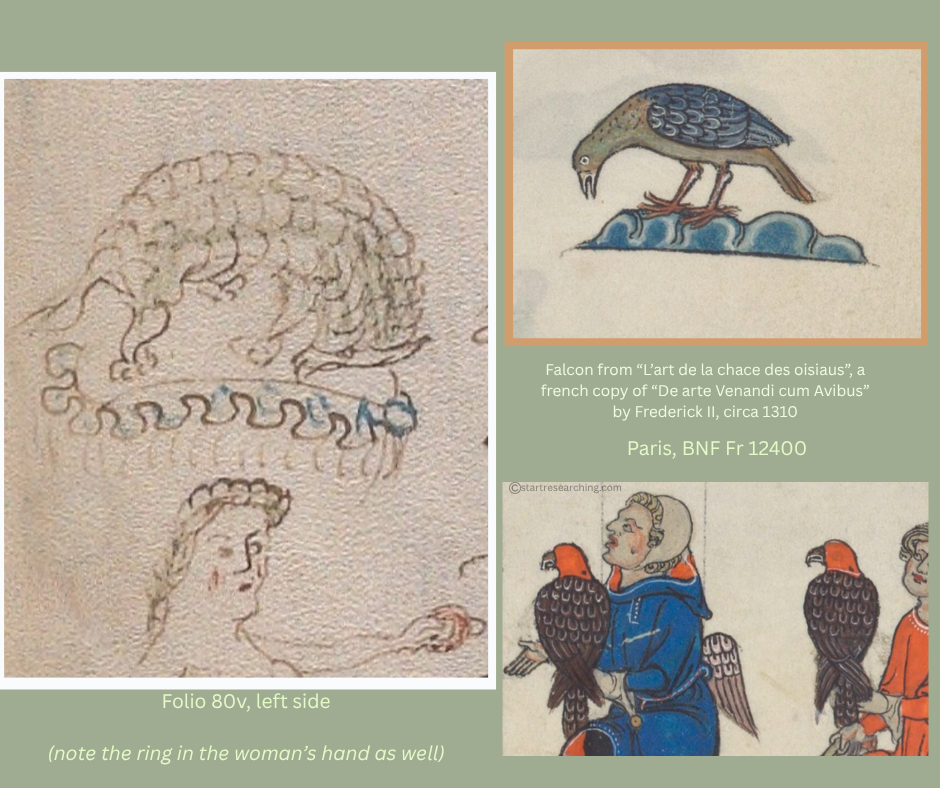
Above: Image parallels between the animal on folio 80v of the Voynich (left) and a falcon from De arte venandi cum avibus (top right and bottom right). Note also the red cheeks on the humans. Not a direct copy, but enough to show why I think this may be a falcon. I also think the Voynich artist made a mistake with the half-erased third leg.
While wearing her new ring, Canacee finds an injured perigrine falcon. The bird laments of a male falcon, or “tercelet”, that broke her heart and abandoned her for another. This tercelet word invented by Chaucer) was described as “so depe in greyn he dyed his coloures” - a play on the word ingrained and the color green. This green, male falcon, or tercelet, represents the malice and evil nature of the male species. Canacee is able to rebuild a shelter and then heal the female falcon with her newfound knowledge of herbs.
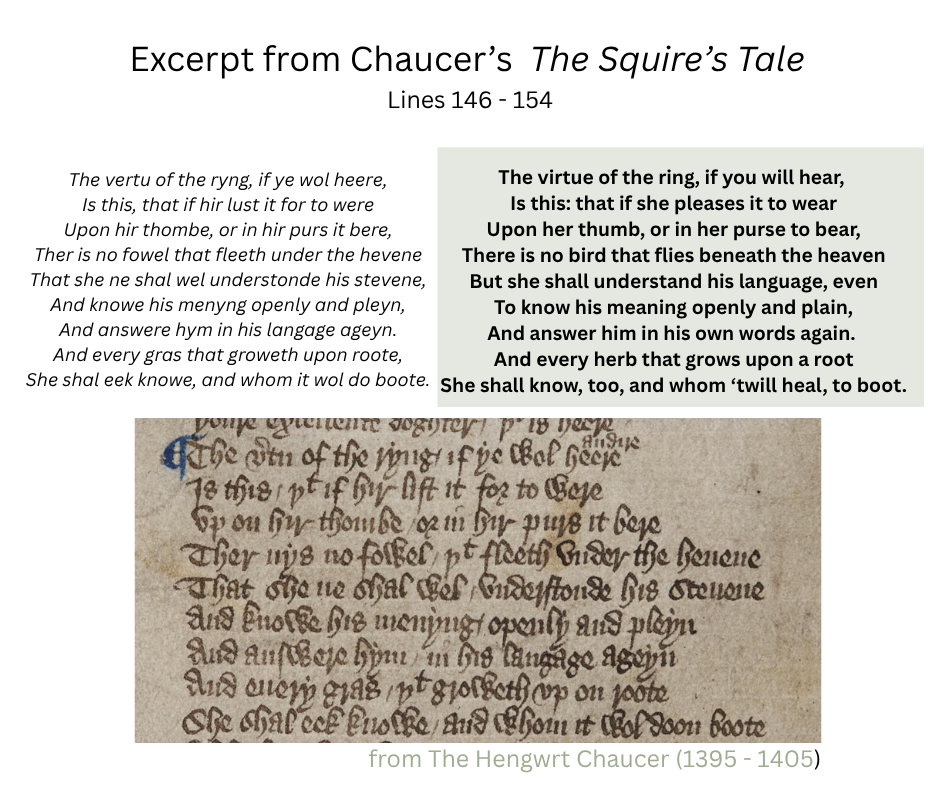
If you would like to read this in Middle English, the two most notable surviving manuscripts of The Canterbury Tales are the Ellesmere Chaucer (The Huntington, mssEL 26 C 9) and the Hengwrt Chaucer (National Library of Wales, Peniarth MS 392D). Both were written by the same scribe, Adam Pinkhurst. Neither have image depictions of the narrative.
Chaucer in Italy?
Now, let’s get into it. This story of The Squire’s Tale was written by Chaucer at the end of the 14th century - before the carbon dating of the Voynich - but the stories themselves did not make their way into Italy until much later, possibly centuries. The first Italian edition, Dalle novelle di Canterbury, wasn’t published until 1897.
Chaucer himself visited Italy before his death in 1400, at least two or three times, on diplomatic missions. In 1372/1373 to Genoa and Florence, and in 1378 to Lombardy, Milan, and possibly Pavia. During his travels he may have crossed paths with Italian humanists. We can make educated guesses based on the timing and who lived in Florence during Chaucer’s first visit, like Coluccio Salutati or Luigi Marsili. And we know he wrote about Petrarch in one of his stories, but there is little evidence they actually met. The Canterbury Tales were supposedly written a decade or so after these visits, so it is unlikely he shared his work with others on these visits.
It is much more possible that Chaucer collected stories during his time in Italy, which he later used in his writings. While the The Squire’s Tale does not have any defined sources, we know his other works drew inspiration from Italian works. Chaucer’s Troilus and Criseyde, The Franklin’s Tale, and the popular The Knight’s Tale came from Boccaccio’s work , Boccaccio himself drawing from Greek epic of Theseus and others.
The Squire’s Tale depicted in the Voynich?
So if the Voynich was written in Italy, as many believe, it is unlikely that The Squire’s Tale from Chaucer’s Canterbury Tales is depicted within it - unless someone had come from, or traveled to England to learn the story. Or the Voynich was written in England - perhaps it is a Roger Bacon cipher after all (how funny would that be).
If it does depict The Squire’s Tale, perhaps this is further evidence of the manuscript being a hoax.
Or perhaps - and most likely in my opinion - the story of the magical ring that gives the wearer the knowledge to understand all animals and to know the magical properties of herbs - likely has earlier traditions. Perhaps Italian, perhaps Arabic or Oriental. Chaucer learned one of these traditions on his travels to Italy, and later wrote the story.
The author, or one of the illustrators, of the Voynich, also knew of one of these traditions. This story fits perfectly in this section of the Voynich (at least according to my own theories!) about how the souls’ acquire knowledge and wisdom, but also moral virtues, on their journey and reincarnations.
And what of BnF 124000?
I included images from Paris, BnF, Francais 12400 in the image comparison above. It is a late 13th century French copy of De Arte venandi cum avibus. It has nothing to do with Chaucer, but is a great treatise on falcons and other birds, and has a lot of image similarities with the possible “falcon” on 80v of the Voynich. I’ll let you draw your own connections.
Sources:
“A Brief Chronology of Chaucer’s Life and Times” Harvard’s Geoffrey Chaucer Website (https://chaucer.fas.harvard.edu/pages/brief-chronology-chaucers-life-and-times-0)
Reynolds, L.D. and N.G. Wilson. “Scribes and Scholars: A Guide to the Transmission of Greek and Latin Literature” Oxford University Press, 1968. As found on the Internet Archive.
Tatlock, John S.P. “The Duration of Chaucer’s Visits to Italy”. The Journal of English and Germanic Philology. Vol. 12, No. 1 (Jan., 1913), pp. 118 - 121. (https://www.jstor.org/stable/27700213)
The National Library of Wales: ‘The Hengwrt Chaucer’ (https://www.library.wales/discover-learn/digital-exhibitions/manuscripts/the-middle-ages/the-hengwrt-chaucer)
Wood, Casey. “The art of falconry: being the de arte venandi cum avibus of Frederick II of Hohenstaufen” 1943. As found on the Internet Archive.