
by Sherri Mastrangelo, 18 November 2026
When I was researching medieval text in circular frames, especially around zodiac imagery, I came across a copy of Liber Scivias by the Benedictine abbess Hildegard von Bingen. Her work, from the 12th century, has come up many times throughout my research of the Voynich. I decided to check her works for any forms of “pox leber”, or goat’s liver, and found a recipe involving goat’s tallow, as part of a remedy for “gicht”, a form of arthritis - not in Liber, but in both Cusaeu de Curea and Physica.
I’ve always thought the image at the back of the book, on 116v, was related to arthritis, as the woman pictured seems to be holding up her arm, looking at her wrist - and with what appears to be a cloth around her lower leg or ankle. Above her, an animal, possibly a goat. A three letter word, and an odd shape holding something inside - which to me, looks a lot like a herbal poultice.
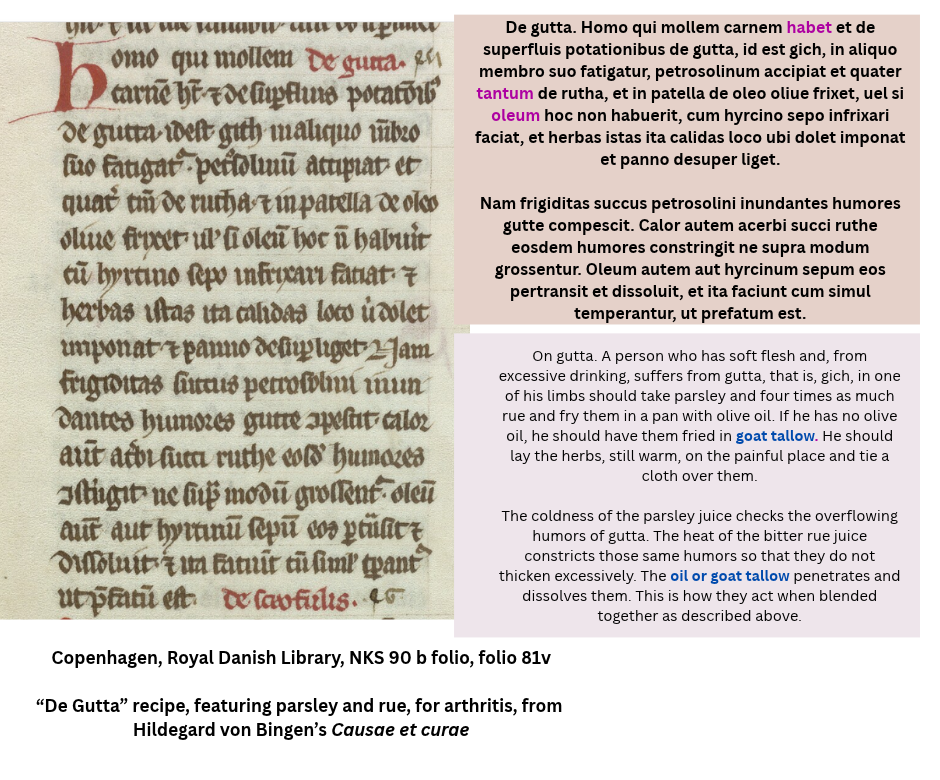
There is a recipe, involving parsley and four times as much rue, fried in a pan with olive oil or goat’s tallow. I’ve included the Copenhagen translation from Cusaeu and the Wolfenbuttel from Physica at the end of this blog post.
The parsley and rue recipe survives in Physica’s Florence, Biblioteca Medicea Laurenziana, Ashburnham 1323 (not digital) and Wolfenbüttel, Herzog August Bibliothek, Cod. Guelf. 56.2 Aug. 4°, both dating from 13th or early 14th century. It is also in her Causae et curae, for which the only whole surviving manuscript is Copenhagen, Royal Danish Library, NKS 90b 2°, from the 13th century (pictured below):
The recipe from Physica in the Wolfenbüttel is a little shorter, and starts about halfway down the page on scan 50:
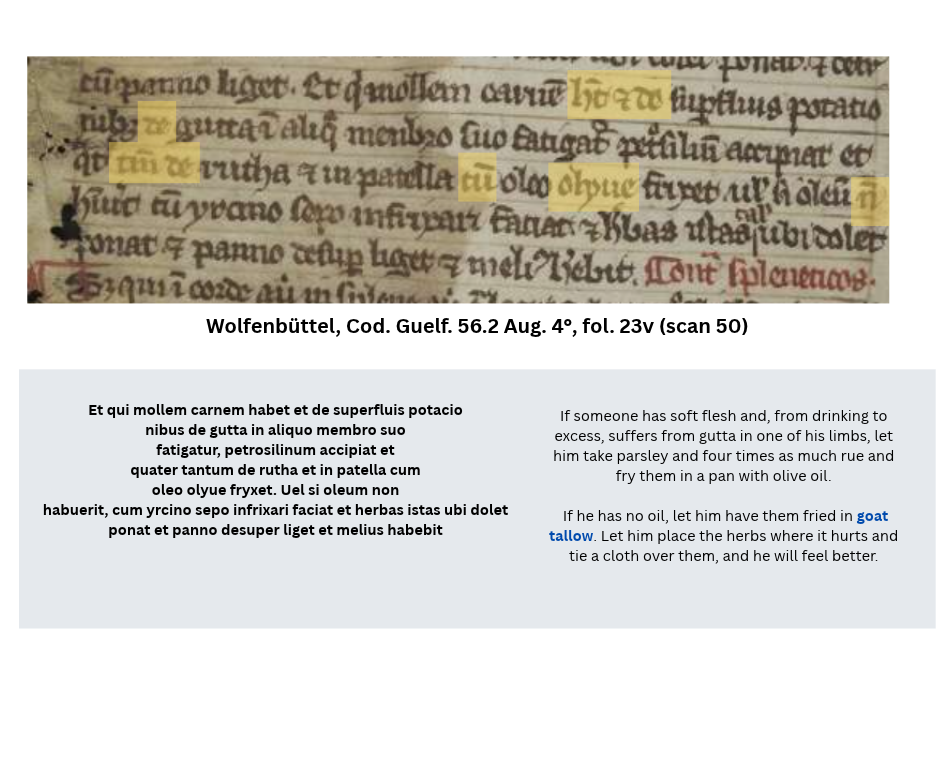
Have you noticed a few similarities with other characters on 116v yet? The most obvious being the sole “n” by itself, an abbreviation for “non”, and the “te” abbreviation, which is actually “de”, meaning “of / from”. I also see a “tm” with a mark over the m, here abbreviated for “tantum”, which I think also appears on 116v as “tam” abbreviated, but that’s part of a different blog post.
Other medieval words for arthritis
In these recipes, Hildegard calls the infliction “gutta” in their limbs, or “gitch”. She does not have a name for this “parsley, rue, oil or goat’s tallow, salve” recipe for painful limbs.
It was not called “arthritis” in the 12th, nor the 15th century - not until the mid 16th century (per the oxford dictionary). The medieval terms from German and Latin included:
Chiragra / cyragra
Gitch / gicht / “das wilde gicht”
Glidgiht / glidsucht / gliedersucht
Gout
Gutta (Latin for drop) - this is what Hildegard called it
Padroga / podroga / podagra
Tropfen / tropfe / “der tropf” (German, the drop) / tropfeln
Zipperlein / zipfen (German)
It was called “the drop”, because they believed one of the humors dripped into the joints to cause swelling and pain.
I believe a version of “tropfen” is the last word in our title, as shown above.
The first part of this word looks like the tironian symbol for “et”, a seven with a line through the stem, meaning “and” (or maybe “und”). I think the next two characters are “zu”, followed by “tpfe(?)” which I believe means tropfen. Together, it would say “and for Tropfen” as the last part of our recipe header.
I did find “und tropfen” as a recipe header in folio 115v of Heidelberg, Cod. Pal. germ. 545, for a paralysis or stroke cure.
Saving the first word(s) of our header, “pox leber”, for another post.
Sources and additional information
International Society of Hildegard von Bingen Studies (https://www.hildegard-society.org/p/academic-sources.html)
Healthy Hildegard (https://www.healthyhildegard.com/causae-et-curae/)
“Tropfe / Tropfen” in the FWB (https://fwb-online.de/go/tropf.rI.0m_1741191397)
Meyer, Ernst-Albert “Gout: That darned little ailment” 6 Dec 2013. PTA Forum. (https://www.pta-forum.de/ausgabe-012014/das-verflixte-zipperlein/)