
by Sherri Mastrangelo, 20 May 2026 - Last edited 22 May 6:43 pm PST
For this post, I am using “The Timaeus of Plato” by R.D. Archer-Hind, M.A., 1888 edition, as found on one of my favorite websites, the fabulous Internet Archive. It is shown in Greek with English translation, though the Stephanus numbers are a little difficult to parse, and thus may be off slightly in my quotes below (also note that these numbers are a 16th century invention, so don’t look for them in the VM).
Additional modern alternatives include translations by Peter Kalkavage, Donald J. Zeyl, Desmond Lee, and R.G. Bury. I have also ordered by Magee, but it’s not here yet.
Noteworthy translations in Latin are by Marcus Tullius Cicero (written 45BC), and Calcidius / Chalcidius (4th Century AD). According to the University of Notre Dame’s Medieval Studies Research Blog (which I’ll call MSRB), the Cicero translation was the primary Latin source until about the 11th Century, then interest shifted to the Calcidius. Both were fragmented versions, Cicero ending at 42b and Calcidius at 53b. I have ordered “On Plato’s Timaeus” by John Magee (2016), which focuses on the Calcidius translation, but it has not arrived yet.
During the Italian renaissance, there was a rise of humanism and resurgence of classical Greek philosophy. This did not start with the Fall of Constantinople, the Florentine Academy, and the Medici family as some believe, but earlier - from Petrarch to Chrysoloras to the Council of Florence. It is here we find the carbon-dating for the paper of the Voynich, along with a wide reverence for Plato.
“Plato’s Timaeus was the most widely available Platonic work throughout most of the Middle Ages” (MSRB), while the Plato catalogue we know today was not. Timaeus was about the universe, the world itself and our place within it. We see this macrocosm of the universe in the Voynich, with the astrology section, followed by the microcosm of the body and soul in the bathing section. To be clear, I am not drawing authorship to Plato by any means. I am, however, almost certain that the Timaeus was referenced, as shown in my associations below.
Let’s start with the biological section, which I believe shows elements of Plato’s Timaeus visually (and likely in the text). Namely, the story of the creation, or reincarnation, of the soul.
In my work with the Voynich I have reordered this section, so that it no longer starts with 75r, but 76r - a page of text. On the reverse, we have 76v. Here we start around section 42E of Timaeus, within the works of Reason, where the creator “gave into the hands of the young gods, to mold mortal bodies, and having wrought all the residue of the human soul that needed yet to be added, to govern and guide as nobly and perfectly as they could the mortal creature”. To do this, -
“they borrowed from the universe portions of fire and of earth and of water and of air, on condition that they should be returned again…and making of all the elements one body for each creature, they confined the revolutions of the immortal soul in a body in-flowing and out-flowing continually…” - Timaeus, 43A
“…and though they are in motion, it is motion without law, sometimes reversed, now slanting, and now inverted…” - 44A
I will not say much about these connections at this time, as I want to draw attention to the images and quotes.
(Here I skip folio 77r and folio 77v)
“but when the stream of growth and nutriment flows in with smaller volume, and the revolutions calming down go their own way and become settled as time passes on, then the orbits are reduced to the form that belongs to the several circles in their natural motion…” - Timaeus, 44B
(I believe next should come 81r and 81v in my order, to the right of 78v)
“…they gave it the body for a conveyance and for ease of going; whence the body was endowed with length and grew four limbs that could be stretched and bent, which the god devised for it to go withal, and by means of which clinging and supporting itself it is enabled to pass through every place, bearing at the top of us the habitation of the most divine and sacred element. In this way then and for these reasons were legs and hands added to all mankind…” - Timaeus, 44E
“…bearing at the top of us the habitation of the most divine and sacred element…” - Timaeus, 45A
“…and first of the organs they wrought light-giving eyes, which they fixed there on the plan I shall explain. Such sort of fire as had the property of yielding a gentle light but not of burning, they contrived to form into a substance akin to the light of every day. The fire within us, which is akin to the daylight, they made to flow pure smooth and dense through the eyes…” - Timaeus, 45C
“…For the gods had devised as a safeguard of the sight the structure of the eyelids; and when these are closed, they shut up the force of fire within; and when these are calmed, quiet ensues…” - Timaeus, 45E
(Since I moved 81r and 81v, next should come 82r)
“…And if the quiet is profound, sleep with few dreams falls on us; but if some of the stronger motions are left, according to their nature and the places where they remain, they engender visions within us, and when we awake are remembered outside us…” - Timaeus, 46A
“…And left appears right and right left, because mutually opposite particles of the visual current and of the object seen come into contact…” - Timaeus, 46C
What follows is harder to place. Did they reference the fragmented Calcidius version, which went only to 53b? If you remember, the translation of Cicero ended at 42b - and since I’ve found connections through 46C I think we can exclude Cicero.
Or more than likely, the Timaeus is only one selection of many, not just of Plato but of others like Socrates and Aristotle - as well as Christian traditions they may have been trying to intermingle (especially based on the ideas of the Council of Florence - which definitely need a closer look here, as it is related to the aspects of purgatory and the purification of the human soul).
That said, I do see other elements of Plato’s Timaeus in other sections. For example, in the zodiac (which we know was after the time of Plato) I noticed this alignment below:
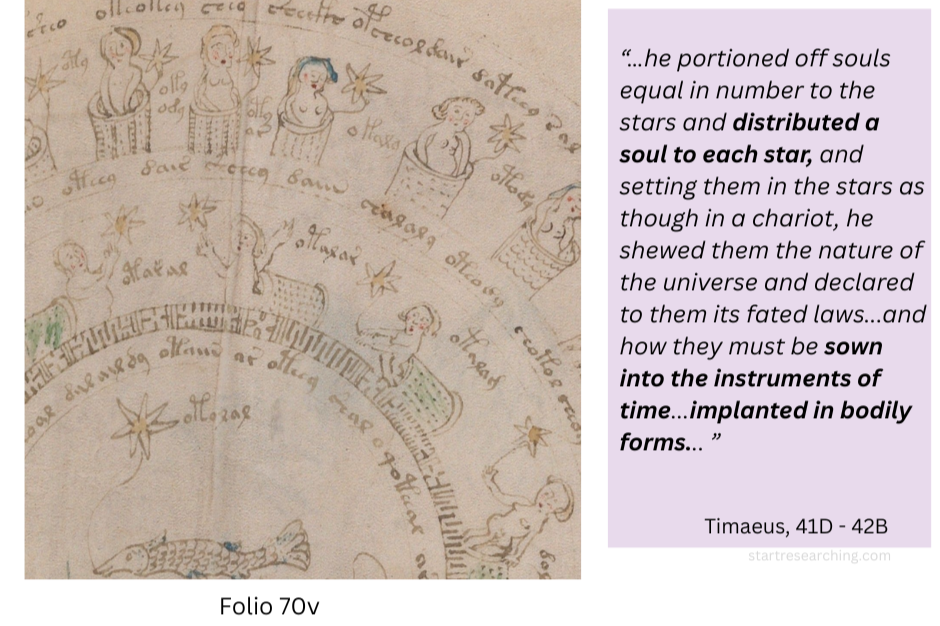
…”he portioned off souls equal in number to the stars and distributed a soul to each star, and setting them in the stars as though in a chariot, he shewed them the nature of the universe and declared to them its fated laws…and how they must be sown into the instruments of time…implanted in bodily forms…” - Timaeus, 41D - 42B
In Folio 70v, I believe it shows not only the stars that each “soul” has been given, but also the metaphorical bodies - or barrels - given to each, which they must escape from, as shown in the inner ring.
The Timaeus is also a great way to link this astrological section with the biological, as it flows perfectly in order within - of the universe, of time and space and planets and the world soul, to the formation of the individual soul and body in the biological section of the Voynich. The way this matches up in order with the Timaeus and flows through so perfectly has me convinced, and I am so excited to research more.
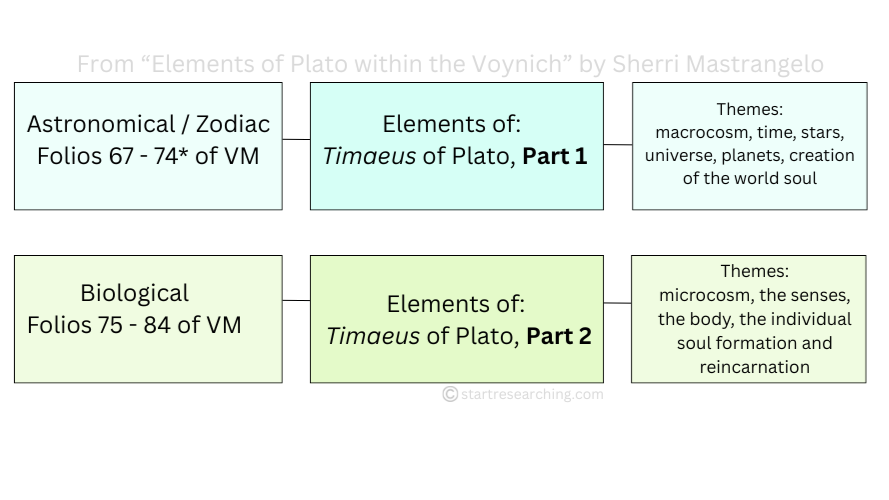
And remember, these quotes from Timaeus are from an 1888 version, and if you want to try to match up any of the text to decipher, your best bet is likely the Calcidius translation, or a different language translation of such.
Perhaps something within this work, like the Pythagorean aspect, or Plato’s favorite numbers, or any of the geometry and forms - has to do with the cipher…
I have much more to say on this topic (the views on time and the universe! other aspects of Plato in other sections! what everything I’ve learned means for the language of the VM!) but will publish this post and edit later as time permits.
Update: I wanted to include a summary of my findings so far, as of Friday night, May 22:
All the best,
Sherri
Sources:
Archer-Hind, R.D., M.A. “The Timaeus of Plato” London, MacMillan and Co., 1888, as found on the Internet Archive.
Kalkavage, Peter. Plato Timaeus, second edition. Focus, an imprint of Hackett Publishing Company, Inc. Indianapolis / Cambridge. 2016. As found online (https://dn710003.ca.archive.org/0/items/plato-keith-whitaker-parmenides-focus-1996/Plato%20-%20Timaeus%20%5Bkalkavage%5D.pdf)
Medieval Studies Research Blog (MSRB). “Plato, Mathematician and Myth-Maker”, Medieval Studies Research Blog: Meet Us at the Crossroads of Everything, Hosted by the University of Notre Dame’s Medieval Institute, 5 June 2024. University of Notre Dame. (https://sites.nd.edu/manuscript-studies/2024/06/05/plato-mathematician-and-myth-maker/)